Semrush is one of the best-known SEO platforms available. It is not a budget option, but it brings together a wide mix of tools for search rankings, content planning, competitor research, PPC, and social media management.
Because the platform covers so much ground, it can feel intimidating at first. Still, anyone with some experience tracking website performance or doing keyword research should be able to get comfortable with it after a short adjustment period.
There is a limited free version for smaller sites, plus a 7-day free trial for the main paid features. Paid plans also come with a 7-day money-back guarantee.
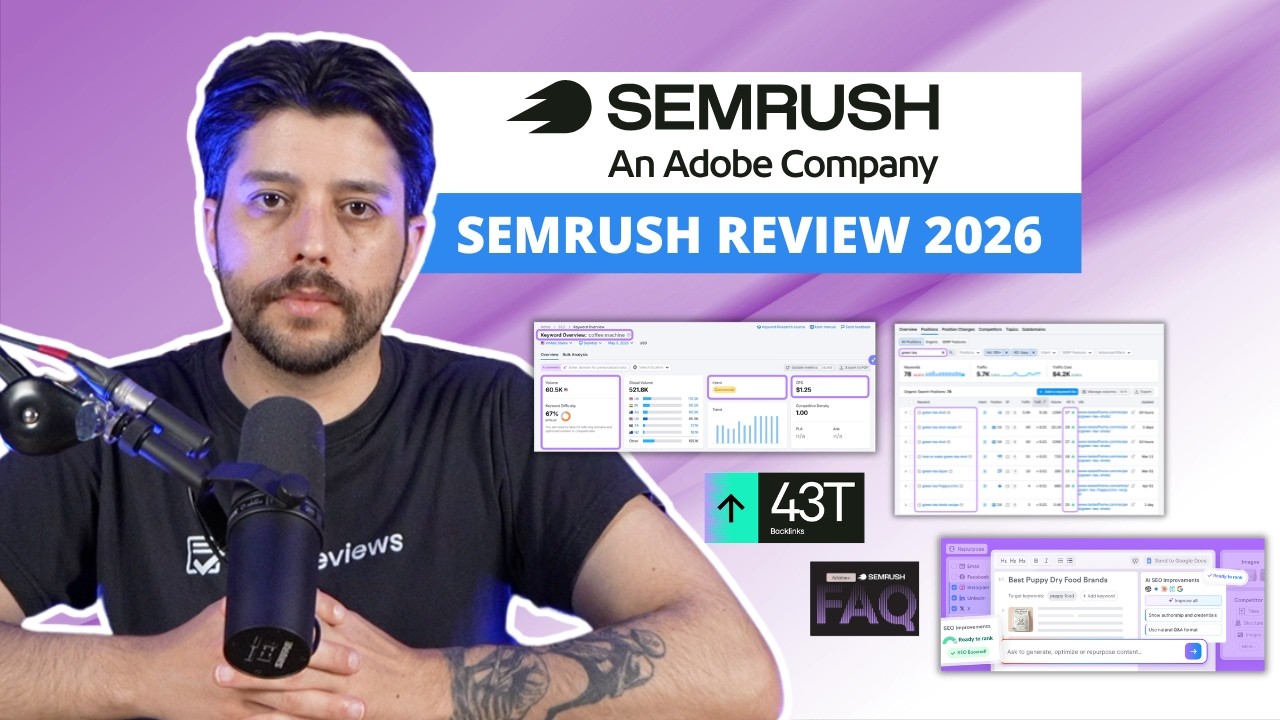
Semrush includes a broad set of tools designed to help you grow traffic, study competitors, and spot issues that may be holding your site back. Experienced marketers will get the most from it, while beginners should expect a learning curve.
The dashboard gives you a quick snapshot of site health, traffic, keywords, backlinks, audits, and AI search visibility. You can also switch views by country and device.
Beyond that, Semrush covers keyword research, content planning, link building, social media, advertising, and reporting.

The first tool we tried was Site Audit, using a connected domain. It scans your site and builds a report covering crawled pages, site issues, JavaScript impact, AI-related data, and other key metrics.
The issues tab breaks problems into clear categories such as errors, warnings, and notices, so it is easy to see what needs attention first.
Examples include internal links with nofollow attributes, unminified JavaScript and CSS, vague anchor text, and pages blocked from crawling.
Just as important, Semrush does not stop at pointing out the problem. It also explains how to fix it.

Position Tracking is another strong part of the platform.
It shows how visible your site is for the keywords you care about and includes data on average position, ranking distribution, keyword impact, and cannibalization.
Semrush tracks Google, Baidu, Bing, ChatGPT Search, Perplexity, and Google AI Mode. That broader coverage is useful if you want to monitor both traditional search and newer AI-driven search experiences.
If your business depends heavily on markets where Yahoo or Yandex matter more, you may still want a second tool alongside it.


One of Semrush's main features is the AI visibility toolkit. Considering how AI has been taking over the internet and how search engines changed, it’s safe to say that it’s an invaluable tool.
This feature offers an in-depth AI analysis of your website’s visibility across Google and AI searches. It allows you to track AI performance, find and fix AI visibility gaps, see what questions people ask AI, and discover how AI platforms portray, position, and communicate your brand.
Thanks to Semrush's intuitive method of showing up metrics, you can easily understand all results. There’s a general AI visibility gauge score and easy-to-read statistics for distribution by LLM (ChatGPT, AI Overview, AI Mode, and Gemini), and mentions by country.
While these are excellent metrics to keep track of, we especially liked the Topics & Sources section of the AI visibility tool. It lets you:


Keyword research is one of Semrush's strongest areas, and there are several tools for different stages of the process.
Keyword Overview is a good starting point. It gives you core metrics for up to 100 keywords at once, including search volume, keyword difficulty, cost per click, related terms, and variations.
Search a broad phrase such as ‘digital marketing’ and Semrush groups results into clusters like agency, courses, and jobs, which makes it easier to narrow your focus. You can also open a quick overview for any result with one click.
If you need more detail, Keyword Magic Tool lets you filter by group and match type. Keyword Gap helps compare your site with competitors, and Keyword Manager lets you save and track up to 2,000 terms.


Link building is another area where Semrush does a solid job. It gives you a detailed look at backlinks, anchors, referring domains, and the overall health of your link profile.
One of the more useful parts is the toxicity scoring, which helps you spot backlinks that may be hurting your domain rather than helping it.
The Backlink Audit Overview makes it easy to review risky links, and you can send disavow requests to Google from within Semrush.
It also points out link opportunities worth pursuing. That is especially helpful for outreach, since it can surface target sites and, in some cases, contact details.


Semrush also goes beyond SEO. If you pay for the separate Traffic & Market plan, priced at $289 per month, you get access to Traffic Analytics for a closer look at markets, niches, and competitors.
It works well alongside Market Overview, helping you see where competitors get their traffic, compare major players in a space, and review demographics.
EyeOn adds competitor tracking, while Audience Profile gives extra detail on audience characteristics such as behavior and socioeconomic data.
For paid search, Semrush can pull ad and keyword data by location, suggest negative keywords, and build ad groups automatically. You can also export campaigns to Google Ads Editor and review which keywords competitors are bidding on.


Content teams have plenty to work with here, too.
Enter a topic and Semrush suggests blog ideas, headline angles, and related questions. It also shows how hard each subtopic may be to rank for and how much potential it has, which helps when deciding what to cover first.
If you want help drafting faster, there is also an AI Article Generator.
The SEO Writing Assistant flags missed best practices, while the SEO Content Template reviews competing pages and suggests keywords, backlink opportunities, readability targets, and recommended length. You can also run a content audit to find older posts that need attention.
For social media, Semrush supports scheduling for Facebook, X, LinkedIn, Instagram, Pinterest, and Google Business Profile. It also tracks audience growth and engagement, demographics, competitor activity, and Facebook and Instagram ads.


Semrush is only available as a web platform, which is mobile optimized if you want to use it on the go. Nonetheless, given the number of features offered, the experience is much better on a desktop.
In terms of add-ons, many of Semrush's extra tools are sold separately. That can be useful if you want to build a broader marketing stack inside one platform, but it can also push the total price up quickly.
Some of the add-ons include:
Semrush connects well with Google tools such as Analytics (GA4), Search Console, and Looker Studio, which helps keep reporting and data sharing in one place.
It also supports Model Context Protocol (MCP), so teams can connect it with AI tools such as Claude, Cursor, and similar assistants.
For larger teams, Semrush offers API access plus native connections for platforms like HubSpot and Zapier, making it easier to pull marketing data into existing workflows.

| Lowest price | $117.33/mo |
| Free trial | 7 days |
| Money-back guarantee | 7 Day(s) |
| Free version |
Semrush pricing can be confusing at first because the base plans are only part of the picture. Once you start adding extra toolkits or more seats, costs rise quickly.
You can begin with the limited free plan, but the 7-day free trial is the better way to judge the platform, since it gives you access to the full Semrush One feature set.
Paid plans start at $117.33 per month on annual billing, and the main tiers are Pro, Guru, and Business. Higher tiers raise the limits on searches and projects, but they also unlock extra features. For example, content marketing tools and keyword cannibalization analysis start at Guru, while API access is limited to Business.
Every plan includes just one user, and extra seats cost more. That makes Semrush a pricey option for teams, especially compared with rivals that include multiple users in standard plans.
In the end, your total cost depends on the plan, billing cycle, number of users, and any add-ons you choose. Annual billing cuts the monthly price by 17% compared with paying month to month.
Semrush accepts major credit cards, wire transfers, and checks for U.S. annual subscriptions.
| 24/7 | |
| Live chat | |
| Phone |
Given how much the platform offers, good learning material matters. On that front, Semrush does well. It has a large knowledge base, a blog, video tutorials, webinars, and Semrush Academy for free courses on SEO, PPC, and related topics.

If you need direct help, there are regional phone lines, including options for the U.S. and Spain, plus an AI chat assistant. There does not appear to be email support, but the chat gave useful answers to both technical and basic questions during our testing.
If you want a guided product tour, you can also book a demo with a Semrush expert.
Semrush is also active on LinkedIn, Instagram, TikTok, YouTube, Facebook, and X.
Semrush is expensive, and the learning curve may put off some first-time users. Even so, it remains one of the strongest all-in-one platforms for SEO, content research, and digital marketing.
Its keyword tools are particularly useful for finding new opportunities and understanding what your audience is actually searching for. That alone can make content planning much more focused.

On top of that, Semrush supports link building, competitor tracking, social media work, paid search research, and content optimization in one place.
Annual billing gives the best value, with plans starting at $117.33 per month after the 17% discount. If you are considering it, the 7-day free trial and 7-day money-back guarantee give you a reasonable window to test it for yourself.
Semrush is a service used for SEO, keyword research, rank tracking, competitor analysis, backlink monitoring, content planning, and PPC research. It’s designed to help businesses and brands improve search visibility, plan content, study competitors, and track marketing performance from one platform.
Semrush is a paid platform, but it offers a limited free version. The paid plans unlock the full feature set, while the free version is better suited to light testing or basic use.
Pricing depends on the plan. Semrush's SEO Classic plans start at $117.33 per month when billed annually. Higher tiers cost more, and extra toolkits or seats can increase the total price.
Semrush can work for beginners, but it is not the easiest platform to learn. It offers a lot of data and tools, which is great once you know your way around, but the interface can feel overwhelming at first.
Yes. Semrush includes AI-related features and also tracks visibility across AI-driven search experiences such as ChatGPT Search, Perplexity, and Google AI Mode. It also offers AI-assisted tools for tasks like content support and broader search visibility analysis.
The Best Reviews team researches and tests all products first-hand. We've been reviewing products and services since 2012 and are proud to only publish human-created content.

Share your thoughts, ask questions, and connect with other users. Your feedback helps our community make better decisions.
©2012-2026 Best Reviews, a clovio brand –
All rights
reserved