If you own a business, texting customers might seem simple.
A customer shares a number, your team sends a message, and the conversation moves faster than it would over email. However, a single unclear opt-in or an ignored STOP request can turn a useful channel into a serious compliance problem.
The truth is that business text messaging compliance protects more than your legal position. It also supports customer trust, carrier deliverability, and the long-term value of your contact list.
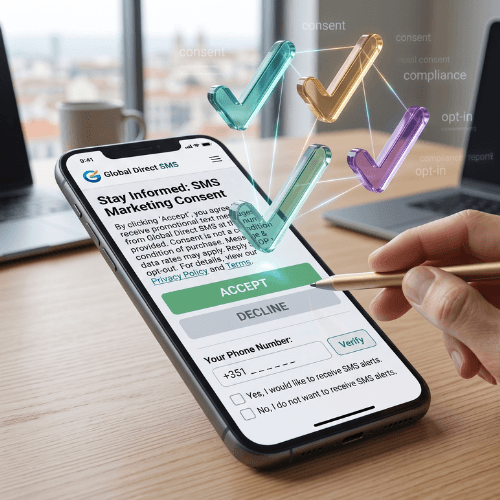
Key considerations include the compliance rules that matter most, the difference between service and marketing messages, and how to build a texting process that can grow without becoming difficult to control.

A compliant business texting workflow must follow a few practical rules:
Three layers shape these requirements:
For example, federal rules restrict telephone solicitations before 8 a.m. or after 9 p.m. in the recipient’s local time, while state laws may be stricter.
That means even a useful message can pose a risk when the consent trail is missing, the sender is unclear, or promotional content is added to a service conversation.

The best and safest way to classify a message is to look at its purpose and content.
The distinction matters because a service message can become promotional. An appointment reminder that says, ‘Your visit is tomorrow at 2 p.m’ is different from one that adds, ‘Book an extra treatment today and save 20%’. That second sentence changes the message’s purpose and may alter the required consent.
When the classification is unclear, use the more conservative standard or have qualified counsel review the campaign.

Automated marketing SMS messages require prior express written consent that clearly connects the person, the business, and the types of messages they will receive.
Consent can be electronic, but it should be specific, voluntary, and easy to prove.
Practical opt-in methods include:
| Opt-in option | Description |
|---|---|
| Website form | The customer enters their phone number and checks a separate, unchecked box confirming they want SMS messages. |
| Checkout or booking form | During a purchase or appointment booking, the customer separately agrees to receive texts. The disclosure should explain what kinds of messages will be sent. |
| Keyword sign-up | The customer texts a word such as JOIN to the business number. The automated reply confirms the subscription and provides opt-out instructions. |
| Paper or digital agreement | The customer signs a document or electronic form that clearly authorizes the business to send text messages. |
The disclosure should name the business, describe the messages and expected frequency, mention that message and data rates may apply, explain how to opt out, and link to relevant terms and privacy information.
You should never hide consent inside broad terms or make marketing consent a condition of purchase when it isn’t necessary.
Keep the form version, disclosure text, timestamp, number, source, and campaign associated with each opt-in. CTIA guidance also advises businesses to build their own consent lists rather than renting, selling, or sharing opt-in lists.
Finally, treat STOP and other clear opt-out language as an immediate instruction, not a request to process later.

Most compliance failures come from ordinary workflow gaps rather than an intentionally reckless campaign. Watch for these red flags:
These mistakes have two consequences. Regulators and consumers may challenge the messages, while carriers may filter or block traffic that looks unwanted. In essence, compliance and deliverability are closely connected.

Ad hoc texting works until several employees, inboxes, numbers, and campaigns are involved. At that point, compliance depends on a system rather than one careful person.
Here’s how to keep control of business texting with a focus on compliance:
Define which message types your business sends, what consent each type needs, and which templates are approved.
Give team members access based on their roles, keep message history visible, and attach consent context to the contact record.
Make sure that automations use the same rules as human senders.
Consent requirements can quickly become complex, especially for businesses new to marketing SMS.
Fortunately, platforms such as VirtualText can reduce manual work by combining a shared inbox with lead capture, automated replies, human handoffs, 10DLC management, and automatic STOP handling. Its compliance controls can block outbound messages to opted-out contacts while preserving the conversation history for the team.
Software doesn’t replace a sound consent strategy, but it can make the approval process easier to follow consistently.
Developed by VirtualPBX, VirtualText is a powerful business text messaging software and U.S.-based communication service for any organization looking to track and improve customer satisfaction.
The standout feature is that you can deploy a webchat widget and move from chat to SMS communication without losing the thread, helping businesses maintain conversation continuity and respond to customers 24/7.
This two-way business texting solution is available as a web and mobile app and offers AI agents, playbooks, team collaboration features, real-time sentiment analysis, and webhooks to optimize workflows.
With no long-term contracts required, VirtualText is available for as low as $99 per month. Before purchasing, users can test the service via a 14-day free trial.
Before launching or expanding a texting program, check the following:
Business text messaging compliance works best as an ongoing operating system, not a box checked once at launch. Rules, campaigns, team access, and customer expectations change, so the process needs an owner and a regular review schedule.
It can be. The final answer depends on the message, technology, relationship, and applicable federal and state rules. Automated promotional texts generally require prior express written consent. Don’t ever assume that receiving a phone number is enough.
The business may face complaints or legal risk if the text is a solicitation and no exception or valid consent applies. To avoid possible issues, check relevant Do Not Call rules, maintain an internal suppression list, and always honor a direct opt-out.
Using a personal phone doesn’t automatically make a promotional text compliant. The message, consent, frequency, and sending method still matter. Personal devices also make recordkeeping and opt-out enforcement harder.
Transactional texts deliver expected service information, while marketing texts promote a product, service, or purchase. Marketing texts usually require a higher level of consent, especially when automated.
Look for consent records, automatic STOP handling, suppression controls, approved templates, shared message history, access permissions, quiet-hour settings, and 10DLC registration support. These controls help teams apply the same rules across manual and automated messages.
Share your thoughts, ask questions, and connect with other users. Your feedback helps our community make better decisions.
©2012-2026 Best Reviews, a clovio brand –
All rights
reserved